Azim Morakabatchi Artworks Exhibition

This exhibition is part of the inaugural Tehran Art Month and is being held both in person and online.
Opening: August 21, 2026 / 16 - 20
The exhibition continues until September 11, 2026.
Visiting Hours: 16 - 20
Mojdeh Art Gallery is Closed on Saturdays.
This exhibition will be held both in person and online.
The Hour of Disaster: 89 - 4 Seconds
The Hour of Disaster, takes its title from the global Doomsday Clock, a symbolic clock introduced in 1947 by a group of scientists who had been involved in the first atomic bomb project (Bulletin of the Atomic Scientists). The clock serves as a metaphor for global crises including nuclear war, climate change, and destructive technologies that could potentially lead to the extinction of humanity. In the Doomsday Clock, the concept of time is understood as an approaching threat. Its hands are symbolically adjusted over time, moving closer to midnight the symbolic point of catastrophe as humanity faces increasingly serious risks.
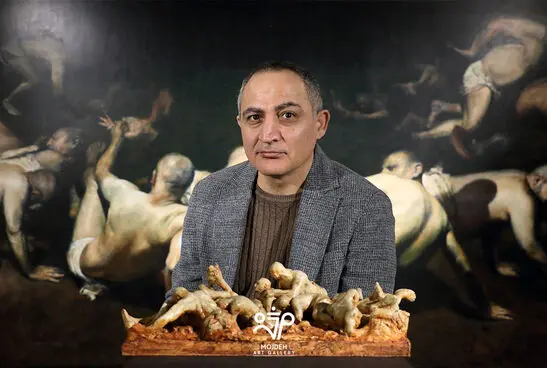
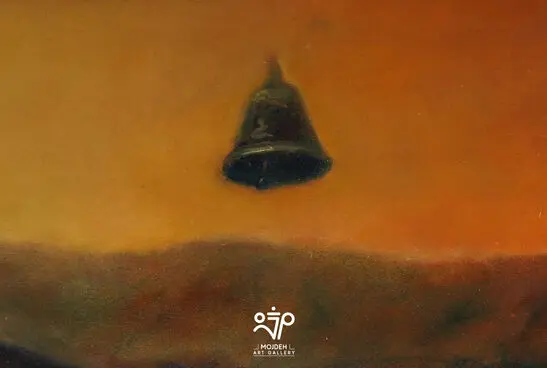
Azim Morakabatchi created this series with the intention of conveying this warning to people around the world. The process through which the series took shape is interdisciplinary in nature; as the idea moves through text, sculpture, and painting, it maintains its conceptual coherence while allowing for reinterpretation within each medium. In this series, Morakabatchi creates key, highly symbolic elements across different media, inviting the viewer into a process of intersubjective contemplation. The bell, as a historical symbol for announcing moments of great consequence, is placed at the center of the composition as a monumental visual representation of sound. Human figures, animals, and a withered walnut tree form a constellation of signs that point to the shared and fragile condition of all forms of life. The setting of the work is both timeless and placeless an element that underscores the sense of disorientation and confusion experienced by the contemporary human being.
“The Last 89 Seconds” did not reach its intended destination in the year it was created. With the outbreak of war and the work’s subsequent absence from public view, it itself came to embody the fate that it had previously sought to represent. A year later, following the adjustment of the Doomsday Clock from 89 to 85 seconds, “Minus Four” was added to the series. This work is not merely a new addition alongside the existing pieces; rather, it introduces the mechanism of change into the very structure of the series.
In “The Last 89 Seconds,” time is the subject of the work; in “Minus Four” it becomes the mechanism through which the work is produced and continues to exist. “Minus Four” is not an image of “85 seconds,” but rather a record of the interval between two temporal states an interval that becomes shorter with each change and compels us to reconsider the present. From this perspective, “Minus Four” is a work of the passage of time, rather than an image of a particular moment in time. It bears the trace of a real change in the external world, one that compels the series to redefine its relationship with the present. If “The Last 89 Seconds” can be understood as a work about time, “Minus Four” is a work created by time.
At this point, “The Hour of Disaster” is no longer merely a symbol or a visual reference; it becomes a temporal mechanism that directly determines the state of the work. The series does not confront the viewer with a fixed image of the future, but places them in relation to the actual time of the world a time that is constantly changing, with each change redefining the state that came before it. The external world, without directly intervening in the process of creation, generates the necessity for change. Thus, the dynamism of the work does not lie in its physical movement, but in its ontological condition and in the process through which the work takes shape and continues to exist. The work is no longer a fixed and final object, but an open structure exposed to time, carrying within it the potential for change, expansion, reinterpretation, and re-creation. “The Hour of Disaster” is an unfinished process in which time, the world, and the artwork are changing in parallel. Now, four more seconds have been lost: only 85 seconds remain before the beginning of disaster.
Saadat Afzood