Walls at the Crossroads of Reality and Imagination

A Semiotic Reflection on Mehdi Sahabi’s Photographs of the Revolution and Graffiti (A Note by Sohrab Ahmadi in Tajrobeh Magazine, No. 31)
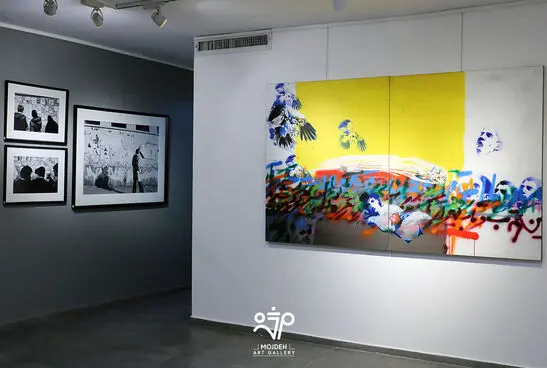
Mehdi Sahabi was, as evidenced by the extensive body of written and visual works he left behind, a multimedia artist. Although he began his career with translation and journalism, he did not confine himself to these fields; rather, he remained active and dynamic within both verbal and non-verbal discourses, working until the very end of his life. This dynamism, his multimedia practice, the connections he established between visual and literary forms of expression, and Sahabi’s inseparable relationship with the society in which he was born and raised can be observed throughout the majority of his works, whether his literary translations or his visual creations. This dimension of Sahabi’s life—his direct impact on, and presence within, contemporary social discourse as an actant—is particularly evident in his collection of graffiti and photographs from the period of the Iranian Revolution. In light of the foregoing, the hypothesis proposed in this article is that the wall constitutes a field of action and agency for Sahabi: at times, he photographs the realities inscribed upon the walls during the Revolution; at other times, he blends these realities with elements of his own imagination and renders them through painting. A selection of these revolutionary graffiti and photographs is currently on view at Mojdeh Art Gallery, curated by Saadat Afzood. In the present essay, we will first attempt to arrive at a definition of the actant, which constitutes the fundamental framework through which we understand Sahabi’s social dimension. We will also consider the wall itself as a semiotic actant for Sahabi in the process of recording history. The essay will then examine the curatorial approach to the exhibition, whose particular emphasis lies on recording history through walls and on a form of documentary and artistic historiography in Sahabi’s distinctive manner. It should be noted that part of the theoretical framework of this essay is based on a component of semiotic theory known as the semiotics of the political. In the second part, which addresses the curatorial project, the discussion is primarily descriptive, with an emphasis on the exhibition’s installation and display process.
The Wall as a Field of Action
An actant can be described as a functional entity that is generally identified by its position within a predicative scene. This position is represented as a role through which the actant participates in the realization of a process. An actant can take any kind of figurative or imaginable form: human or non-human actants, animate or inanimate figures, thoughts, and so forth. Although the definition of the actant in semiotics is very broad and cannot readily be assigned a specific or figurative content, its effect as a role can be delimited. These roles include subject, object, sender, and receiver; in the Greimasian model, primary and secondary actants; and, in Coquet’s model, the transcendent actant. Each of these actantial roles can be attributed to one or more actants. (Fontanille, 23: 2021) In Sahabi’s series of wall paintings, and broadly speaking, it can be said that all of the paintings lack collective human actants. What can be traced in each painting are only several inscriptions, a portrait of the artist himself, and several other portraits that have been figurativized.
In the photographic series as well, Sahabi generally places crowds, or collective actants, at the margins of the frame in order to foreground the wall. The primary focus and framing are determined by the wall and its inscriptions, while the collective actants are of interest only insofar as they are engaged in reading the wall, a newspaper, or a news report. Taking the point made above into consideration, the collective actants in the photographs are regarded solely as a crowd, and their manifestations of action are largely limited to reading the walls and proclamations. What matters, therefore, is the size of the crowd rather than the figurative and conceptual manifestations of action associated with the notion of “the people.”
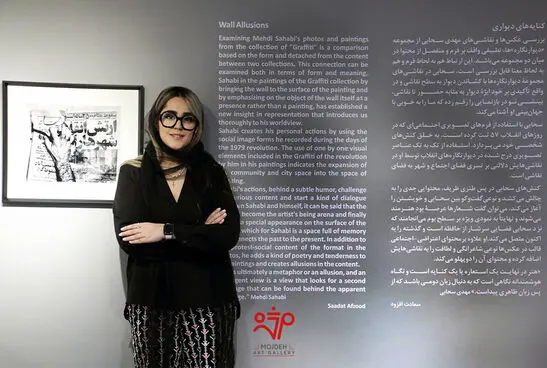
In fact, for Sahabi, the principal actant is the wall itself: it speaks. It is precisely these allusions and utterances of the wall that have led us to base our hypothesis on the premise that the wall functions as an actant in the role that the French semiotician and linguist Jean-Claude Coquet calls the transcendent actant. Coquet writes: “[…] the transcendent actant can be reason, science, society, and so forth. It is through this actant that the text takes shape […] and it is also through it that the narrative is advanced.” This transcendent actant also leaves traces of individuals behind. In Sahabi’s photographs and wall paintings, we can observe that society, functioning as a transcendent actant, assumes the principal role in shaping and taking form on the walls. At the same time, the traces of individual and popular actants remain discernible, although the primary manifestation of society takes place upon the surface of the wall. Indeed, within this mode of actancy, the distinction between historical enunciation and discursive enunciation —the former connecting the utterance to a not-here, not-now, and not-I, and the latter connecting it to here, now, and I—becomes blurred, and all elements are brought together within an objective process. It is for this reason that, for Sahabi, the transcendent actant of society inscribes the entire process of history onto the walls, transforming the wall into the arena of society. Considering the points discussed above, the photographs and paintings presented at Mojdeh Art Gallery now constitute another kind of field as well. The photographs were not printed during Sahabi’s lifetime, and the experience of encountering them in printed form differs from the direct, eye-to-eye encounter Sahabi had with the walls through the camera. The paintings, however, have been exhibited previously and are therefore more familiar to viewers. The exhibition also includes a statement that refers both to Sahabi’s actancy within the realm of the wall and to the wall itself as an actant. The juxtaposition of photographs from the period of the Revolution with the wall paintings, together with the manner of their installation, more clearly evokes a process of fragmentation and the assembly of a puzzle—one that begins with a newspaper crumpled by an individual actant and concludes with a wall painting. One of the most important aspects of this project is its attention to Mehdi Sahabi’s particular use of Persian script, which appears in almost all of the photographs and wall paintings. Some of these lines of script are legible, some illegible, while others have been covered over yet retain the overall form of the script. Sahabi employs these lines as a means of constructing his own particular form of historiography. This distinctive approach to history, which was also touched upon in the previous section, is among the exhibition’s significant points: people remain on the margins of the historical event and possess only a kind of figurative manifestation. In this way, Sahabi demonstrates how walls, although silent, constitute the primary arena of history.
Sohrab Ahmadi